


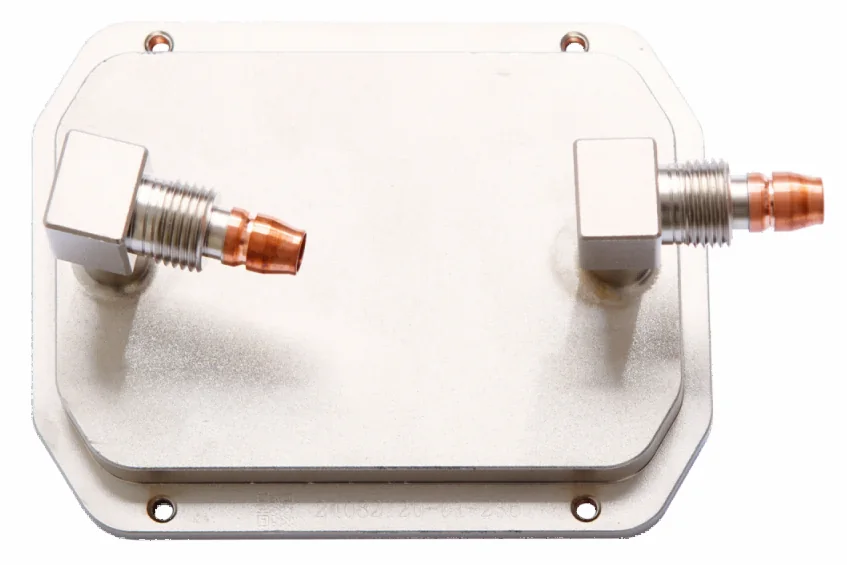
How a GPU Microchannel Cold Plate Works
A cold plate creates a short heat path from the GPU package into a moving coolant. Heat crosses the thermal interface material and contact base, spreads through the plate, and reaches internal wetted surfaces. Small passages can increase surface area and the heat-transfer coefficient, helping remove high local heat flux from a compact footprint.
Smaller passages also increase manufacturing and operating sensitivity. Burrs, particles, channel variation, trapped gas, coolant viscosity, fouling, and corrosion products can raise pressure drop or reduce local flow. The design must balance thermal resistance against pump demand, cleanliness capability, manufacturability, and lifecycle reliability.
Cold Plate Body, Port Adapters, Connectors, and Hoses
| Element | Function | Critical questions |
|---|---|---|
| Cold-plate body | Creates the thermal contact surface and internal coolant boundary | What are the base thickness, flatness, channel architecture, joining process, and pressure limits? |
| Port adapter | Transitions from plate ports to external fluid connections | How is it sealed, oriented, torqued, retained, and protected from side load? |
| Quick disconnect | Provides a serviceable mating interface where the system requires it | What standard, pressure drop, valve behavior, seal, cycle life, and residual spill apply? |
| External hose | Routes coolant to the manifold or adjacent assembly | What coolant, pressure, temperature, bend radius, permeation, and fitting retention apply? |
Cold Plate Selection Inputs
- Thermal map: device heat load, local heat flux, contact footprint, temperature limit, and allowable thermal resistance.
- Mechanical interface: package keep-outs, mounting holes, preload, flatness, roughness, thermal interface material, and board deflection limits.
- Hydraulic envelope: coolant properties, inlet temperature, flow range, pressure drop, operating pressure, transients, and air-removal strategy.
- Fluid interfaces: inlet and outlet direction, port thread or geometry, adapter orientation, sealing method, torque, hose routing, and connector standard.
- Materials: base, cover, adapters, joining materials, coatings, seals, hoses, and compatibility with the entire coolant loop.
- Reliability: leak rate, proof pressure, thermal and pressure cycling, corrosion, vibration, shock, connector cycles, and cleanliness.
Manufacturing and Internal Cleanliness
Microchannels may be machined, etched, formed, skived, or produced by another controlled method before the cover is joined. The route affects geometry, burr control, surface condition, distortion, inspection access, and production scale. A supplier needs a defined final-state drawing and acceptance plan rather than a channel concept alone.
Cleaning is a functional requirement. Particles that look insignificant beside a conventional pipe can restrict a small passage. Define machining-fluid removal, particle limits, rinse chemistry, drying, handling, capping, and packaging. If internal geometry cannot be inspected directly after joining, agree on validated process controls and indirect verification before production release. See our microchannel cold plate machining guide.
Installation and Testing
- Inspect the contact face, mounting points, ports, seals, and cleanliness before assembly.
- Apply the specified thermal interface material with controlled coverage and thickness.
- Seat the plate without sliding across sensitive components or trapping debris.
- Tighten hardware in the approved sequence to the specified torque, angle, displacement, or spring compression.
- Connect adapters and hoses without exceeding torque, bend radius, or side-load limits.
- Perform the required leak and proof-pressure tests with documented instruments and parameters.
- Measure flow and pressure drop at a controlled fluid temperature; perform thermal testing under the defined heat-load and sensor method.
- Record results, dry or fill as specified, cap interfaces, and preserve traceability.
Air, water, or tracer-gas methods can each be useful, but they do not produce interchangeable evidence. Select the method and acceptance limit from the actual failure risk. Review cold plate leak testing methods before writing the production test plan.
Coolant and Corrosion Compatibility
Do not select materials independently. A plate that performs well alone may create galvanic or chemical risk when connected to a loop containing aluminum, copper alloys, stainless steel, plated parts, elastomers, polymers, solders, brazes, and treatment chemicals. Define coolant concentration, pH, conductivity, inhibitors, dissolved oxygen, contamination limits, sampling, and replacement criteria.
The color of the reference image cannot prove a copper cold plate or a particular alloy. Require material certificates, coating or plating specifications, and a controlled wetted-material list for the production part.
Frequently Asked Questions
What is a GPU microchannel cold plate?
It is a liquid-cooled heat exchanger that places small internal coolant passages near a GPU contact region to increase heat-transfer area and reduce the conduction path.
Can the internal channels be confirmed from an exterior photo?
No. Channel geometry, dimensions, joining method, and materials require a controlled drawing, section data, CT evidence, or supplier documentation.
What do cold plate port adapters do?
They transition between the cold-plate ports and external hoses or quick disconnects while controlling orientation, sealing, and service access.
Should every cold plate be pressure tested?
The sampling plan and test method must follow project risk and requirements. Leak-critical applications often require unit-level leak testing plus qualification and periodic verification.
What information is needed to select a GPU cold plate?
Provide device and contact geometry, heat-load map, temperature limits, mounting, coolant, flow, pressure drop, pressure, materials, interfaces, envelope, reliability, and test requirements.